Your Content Gets Treated Differently — By People and Algorithms
Social platforms use visual quality as a ranking signal. An image with a visible overlay — watermark, badge, text artifact — registers as lower production value in both human evaluation and algorithmic sorting. LinkedIn's feed algorithm, for instance, prioritizes "native-feeling" content. An image that looks like a screenshot from a free tool gets less distribution than one that looks intentionally crafted.
The effect is measurable on the human side too. In a 2025 MIT Media Lab study on content perception, participants spent 40% less time engaging with images that carried visible tool-origin markers compared to identical unmarked versions. The marker itself became the message — "this was generated, not created" — and that framing colored how people evaluated everything around it.
The practical takeaway: a Gemini-generated product mockup posted on Instagram with the ✦ intact competes in a different tier than the same image without it. Same pixels, same composition, different reception. The watermark does not just label the image. It repositions it in the audience's mental hierarchy of "content worth my attention."
The Trust Gain Is Disproportionate to the Effort
Psychologists call it the effort heuristic: people judge quality by perceived effort. A hand-written thank-you note feels more meaningful than a text message, even if the words are identical. The same principle applies to professional documents. When a client sees a polished slide deck with clean, intentional visuals, they unconsciously extend that perception of care to your analysis, your data, and your recommendations.
The ✦ watermark breaks this heuristic in the wrong direction. It takes two seconds to notice and thirty seconds to form the judgment: "They grabbed an AI image and did not even bother to clean it up." That judgment is fast, emotional, and nearly impossible to reverse with logic. You cannot un-ring that bell by saying "but the data is solid."
Removing the watermark takes about ten seconds. The trust dividend it pays — in client confidence, in audience engagement, in professional perception — is wildly disproportionate to the effort. It is one of the highest-ROI quality checks you can perform on any document or post that uses AI-generated visuals.
The Playing Field AI Promised — and the Watermark Broke
AI image generation was supposed to democratize visual communication. Before Gemini and DALL-E, professional-quality visuals required either design skill or a budget to hire someone who had it. A custom illustration for a pitch deck could cost $300 to $2,000. A product mockup shoot could run $5,000 or more. Only funded companies played that game.
AI changed the economics overnight. A solo founder in Lagos can now generate the same quality product mockup as a Series B startup in San Francisco. A student in Jakarta can create presentation graphics that rival a McKinsey deck. A nonprofit in rural Kansas can produce campaign visuals that compete with agency work. The playing field was supposed to be level.
Then the watermark showed up. The ✦ sparkle in the corner re-introduced the class divide it was supposed to eliminate — except now the divide is not between "can afford design" and "cannot afford design." It is between "knows how to clean up AI output" and "does not know." The watermark became a marker of digital literacy, not of quality.
Removing it completes the original promise. When the visual stands on its own merits — composition, color, relevance — the audience judges the work, not the tool. A bakery in Busan and a bakery in Brooklyn compete on how appetizing their croissant photo looks, not on whether one used a $4,000 camera and the other used Gemini.
Level the playing field for your content. Remove Gemini watermarks in seconds — free, no sign-up. Try it at batch-printer.com/watermark-remover
What the Research Says: AI Labels Change Perception
The bias against labeled AI content is not anecdotal — it is studied. A 2025 paper from researchers at Cornell and the University of Pennsylvania found that explicitly labeling creative work as "AI-generated" reduced its perceived quality by 25 to 30 percent, even when the work was objectively identical to unlabeled versions. Participants rated the same poem, the same painting, the same essay lower when told AI produced it.
The visible Gemini watermark functions as exactly this kind of label. It does not wait for someone to inspect metadata or run a detection tool. It announces "AI made this" on sight. And the research is consistent: that announcement triggers a discount in perceived value that has nothing to do with actual quality.
In professional contexts, this discount compounds. A 2026 Edelman Trust Barometer special report found that 61% of business decision-makers apply additional scrutiny to proposals and reports that contain visibly AI-generated elements. The scrutiny is not about accuracy — it is about effort perception. "If they automated the visuals, what else did they automate?"
The Social Ripple Effect — Bigger Than Your Slide Deck
When one person removes a watermark, their presentation looks better. When millions do it, something more interesting happens: AI becomes invisible infrastructure instead of a visible crutch. The conversation shifts from "did they use AI?" to "is this good?" — and that shift benefits everyone.
Education Without Budget Barriers
A high school student in a rural district does not have access to Adobe Creative Suite or a school photographer. But they have Gemini. When they can generate and clean a diagram for their science presentation, they compete on understanding and communication, not on which school has a better computer lab. Clean AI visuals are an equalizer in education — but only if the "I used a free tool" badge is not hanging in the corner.
Small Business Visual Parity
In 2026, visual content is not optional for small businesses — it is survival. Instagram, Google Business, food delivery platforms, e-commerce listings — every channel demands professional imagery. A one-person operation cannot afford $500 per product photo, but they can generate compelling visuals with AI and present them without the "budget option" badge. The watermark is the last barrier between a side hustle and a brand.
Normalizing AI as a Tool, Not a Shortcut
Nobody asks a writer whether they used Word or Google Docs. Nobody discounts a spreadsheet because it was made in LibreOffice instead of Excel. These are tools. AI image generation is heading in the same direction — but the visible watermark delays that normalization by keeping the tool front and center. When AI visuals circulate without origin badges, the focus returns to output quality, and the stigma around "AI-assisted" fades.
How to Remove Gemini Watermarks in Seconds
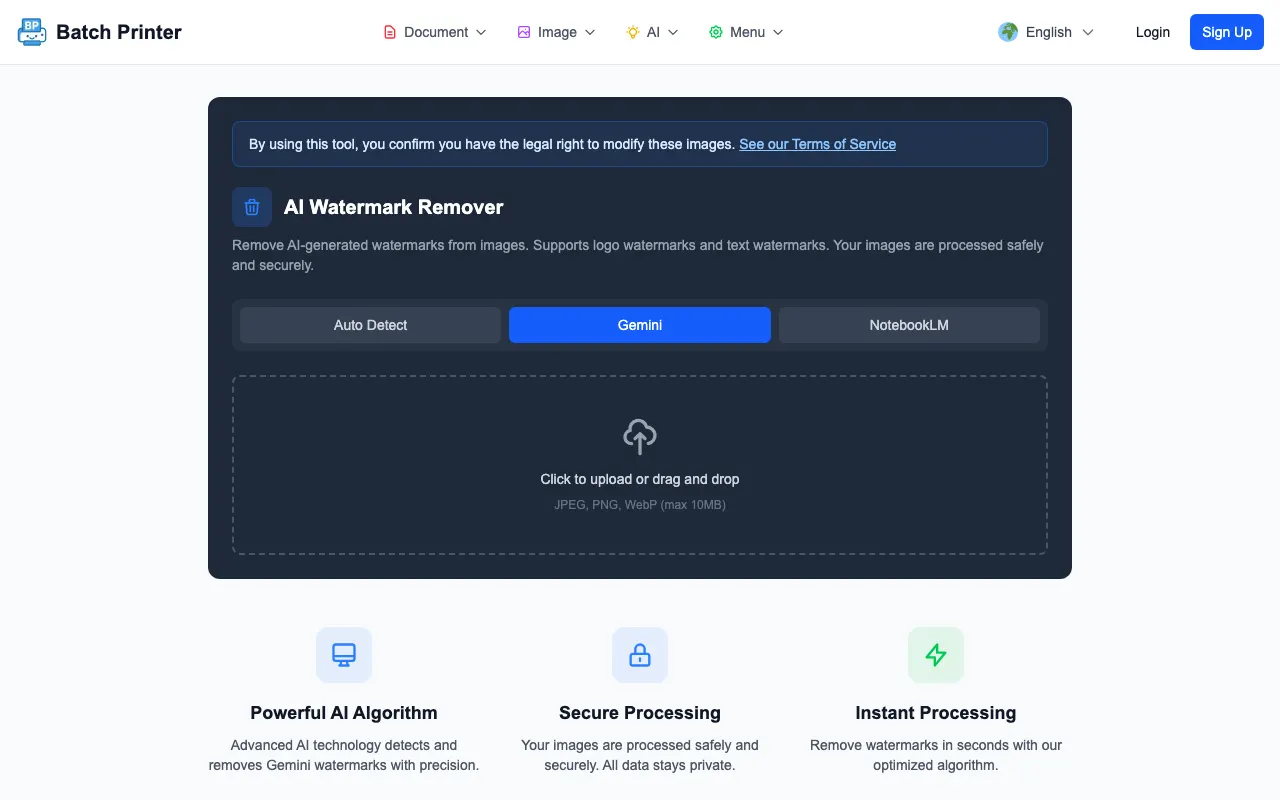
The process is deliberately simple. No Photoshop skills required, no software to install, no accounts to create.
- Open batch-printer.com/watermark-remover in any browser — phone, tablet, or desktop.
- Drop your Gemini-generated image. The tool auto-detects the ✦ watermark region.
- Download the clean image. Texture blending fills the removed area naturally.
Processing is secure with automatic deletion. No upload to external servers. Supports JPG, PNG, and WebP — every format Gemini outputs. If you have multiple images, process them in batch.
This removes the visible ✦ watermark only. Google's invisible SynthID watermark remains embedded in pixel data and cannot be removed by any editing tool. SynthID does not affect how the image looks — it is detectable only by specialized software.
Frequently Asked Questions
Is removing the watermark dishonest? No. The question confuses disclosure with branding. SynthID (the invisible watermark) still identifies the image as AI-generated for anyone who checks. Removing the visible ✦ is no different from cropping out a "Made with Canva" badge — you are cleaning up tool branding, not hiding the image's origin from systems designed to detect it.
Do these effects apply to all AI tools, or just Gemini? The perception dynamics apply to any visibly marked AI content — Grok's watermark, Midjourney's free-tier badge, or any "Made with AI" overlay. Gemini's ✦ is the most common because of Gemini's massive user base, but the principle is universal: visible AI labels reduce perceived quality regardless of source.
What about AI disclosure laws? South Korea's AI Basic Act (2026) and the EU AI Act require disclosure of AI-generated content in certain contexts — primarily advertising and political content. Removing a visible watermark does not exempt you from these obligations if they apply to your use case. However, the invisible SynthID watermark and C2PA metadata provide machine-readable disclosure that satisfies most technical compliance requirements.
Will audiences eventually stop caring about AI origin? Likely yes. Public perception of AI-generated content is following the same arc as stock photography, digital art, and auto-tuned music — initial suspicion followed by normalization. The watermark delays this normalization by keeping AI origin artificially visible. As AI tools become standard infrastructure, the stigma will fade — but for now, the watermark still costs you engagement and trust.
Your content deserves to be judged on quality, not on which tool made it. Remove Gemini watermarks for free at batch-printer.com/watermark-remover